Net Metering Solar System in Bangladesh
Last updated:
A net metering solar system in Bangladesh is a rooftop or ground-mounted PV plant, connected to the distribution network, whose spare daytime output is exported and logged by a two-way (bi-directional) meter. Your bill is then based on net consumption: energy imported minus energy exported. It works under the government's Net Metering Guideline, administered with SREDA and the distribution utilities.
Part of our Solar Systems in Bangladesh.
Most factories, offices, hospitals and schools in Bangladesh use the bulk of their electricity during daylight hours, which is exactly when solar panels produce. Even so, there are times when the roof generates more than the building uses: a Friday, a holiday, a lunch break or a day when a production line is down. Without net metering that surplus has nowhere useful to go. With net metering it is exported to the grid and credited against the energy you draw at night or on cloudy days.
Veritas Technologies Ltd designs, supplies and installs grid-connected solar systems and supports clients through the net metering process with their distribution utility. The work builds on our electrical design and safety assessment experience, so the solar plant is treated as part of your whole electrical installation rather than a separate add-on. Net metering itself is a billing arrangement; the physical plant underneath it is an on-grid solar system, most often mounted on a roof.
What Is a Net Metering Solar System?
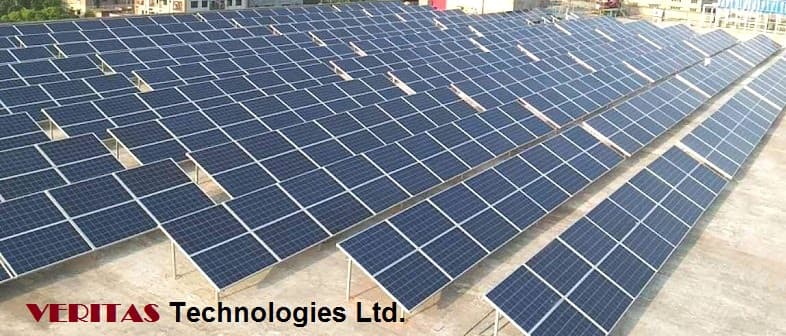
A net metering solar system is a grid-tied photovoltaic (PV) plant whose surplus output is allowed to flow back into the public distribution network and is measured for billing. It has three essential parts: the solar array and grid-tie inverter that produce AC power in step with the grid, the protection and switching equipment that connects that power safely to your main distribution board, and a bi-directional (net) meter installed by the utility that records energy in both directions.
During the day, solar output serves your running loads first. When generation exceeds demand, the excess passes through the meter into the grid and is logged as export. When demand exceeds generation, at night or under heavy cloud, you import from the grid as usual. At the end of the billing period the utility calculates the net figure. How any excess export is carried forward or settled is defined by the guideline and your utility's billing procedure, so confirm the current method with your utility before you rely on it in a financial model.
How Does the Net Metering Guideline Work in Bangladesh?
Net metering in Bangladesh operates under the government's Net Metering Guideline, first issued in 2018 and revised since. It is administered with the Sustainable and Renewable Energy Development Authority (SREDA) and applied in practice by the distribution utilities that serve each consumer. The guideline sets eligibility, capacity limits relative to the sanctioned load and the billing method, and it lays down the technical expectations for grid-connected equipment.
Because the guideline has been revised and utilities issue their own forms and procedures, we always check the current version and the requirements of your specific utility at the start of a project. Capacity, metering and billing figures used in your feasibility study should come from that check, not from older articles or a neighbour's experience.
Which distribution utilities are involved?
The utility you deal with is the one that supplies your premises. Across Bangladesh this may be the Bangladesh Power Development Board (BPDB), Dhaka Power Distribution Company (DPDC), Dhaka Electric Supply Company (DESCO), the Rural Electrification Board (REB) through the local Palli Bidyut Samity (PBS), West Zone Power Distribution Company (WZPDCO) or Northern Electricity Supply Company (NESCO). Each handles the application, technical review, inspection and meter change for its own consumers.
Who can apply?
In broad terms, consumers with a valid grid connection in their own name, an account in good standing and a suitable roof or premises can apply. Industrial, commercial, institutional and residential customers are all covered in principle, subject to the conditions in the guideline. Tenants usually need the building owner's consent because the plant sits on the owner's structure.
Who Needs a Net Metering Solar System?
Net metering makes most sense where a site has usable roof space and a daytime load that solar can serve, but where generation will sometimes exceed demand. Typical users include:
- RMG and textile factories with large shed or flat roofs and weekly or holiday shutdowns.
- Warehouses and logistics centres whose roofs are far larger than their electrical demand.
- Commercial buildings, shopping centres and offices with weekend dips in consumption.
- Hospitals, clinics, schools, colleges and universities aiming to reduce grid purchases.
- Apartment buildings where a shared roof array can offset common-area loads such as lifts, pumps and lighting.
- Businesses with buyer or group sustainability targets that want renewable generation recorded on site.
If your daytime load is always larger than any solar plant your roof can hold, net metering adds little; a straightforward on-grid system for self-consumption may be enough. A load and roof study tells you which case applies.
What Equipment Does a Net Metering System Need?
The equipment list is similar to any well-built grid-connected plant, with particular attention to the items the utility will inspect.
- PV modules certified to IEC 61215 (design qualification) and IEC 61730 (safety).
- A grid-tie inverter with anti-islanding protection, so it disconnects automatically when the grid fails, plus voltage and frequency protection settings acceptable to the utility.
- Mounting structure designed for the roof type and wind loads, with corrosion-resistant fixings.
- DC protection: string fuses where required, DC isolators and DC surge protection devices (SPDs).
- AC protection: a suitably rated breaker, AC isolator and AC SPD between the inverter and the main distribution board.
- Earthing and equipotential bonding for module frames, structures and inverter, coordinated with any lightning protection system.
- A bi-directional (net) meter supplied or approved by the utility, and in many cases a separate solar generation meter.
- Monitoring through the inverter's data logger or a site energy management system.
Why the grid-tie inverter matters
The inverter is the boundary between your plant and the public network. It synchronises its output to grid voltage and frequency, tracks the maximum power point of the array and, critically, stops exporting within a short time if the grid is lost. This anti-islanding behaviour protects utility staff working on lines they believe are dead. Utilities typically ask for test certificates or data sheets proving it, so choose a model whose documentation is complete.
How Do You Get a Net Metering Connection? Step-by-Step Process
Exact forms differ by utility, but the path for a net metering solar system in Bangladesh usually follows these steps:
- Collect 12 months of electricity bills, the sanctioned load, meter details and building drawings.
- Site survey: roof condition, area, orientation, shading, access and route to the main distribution board.
- Load-profile analysis and system sizing within the limits the guideline allows for your sanctioned load.
- Structural check of the roof and mounting design, with strengthening proposals where needed.
- Electrical design: single-line diagram, cable and protection sizing, earthing and inverter settings.
- Preparation and submission of the net metering application with drawings and equipment data sheets to the distribution utility.
- Technical review by the utility, which may ask questions or request changes.
- Installation of modules, inverters, protection and earthing by trained teams.
- Pre-commissioning tests and documentation in line with IEC 62446.
- Utility inspection, installation or replacement of the bi-directional meter and signing of the net metering agreement.
- Commissioning, start of net billing and handover of operation and maintenance documents.
How Is a Net Metering Solar System Sized?
Good sizing balances three limits: what the roof can physically hold, what the guideline permits relative to your sanctioned load, and what makes financial sense for your consumption pattern. We start from the load profile, ideally from interval or demand data, otherwise from monthly bills and an inventory of major loads and operating hours.
A system sized to match daytime consumption keeps most generation on site, where it displaces energy you would otherwise buy. A larger system exports more, which net metering credits, but the value of each exported unit depends on the billing method in force. Roof area sets the physical ceiling; shading from water tanks, parapets, stair rooms and neighbouring buildings reduces usable area and must be modelled, not guessed.
We also check the existing electrical installation: transformer capacity, main breaker rating, busbar space and the condition of the main distribution board. An old or overloaded board can become the real constraint, and it is cheaper to discover that at design stage than during the utility inspection.
Net Metering vs On-Grid Without Net Metering vs Hybrid and Off-Grid
The table compares the main options for a site that is connected to the grid or considering solar for the first time.
| Feature | Net metering solar | On-grid without net metering | Hybrid / off-grid |
|---|---|---|---|
| Grid connection | Yes, with export permitted | Yes, export usually blocked or limited | Hybrid: yes; off-grid: none |
| Surplus solar | Exported and credited on the bill | Curtailed by export limiter or wasted | Stored in batteries or curtailed |
| Meter | Bi-directional (net) meter | Normal import meter | Normal meter or none |
| Power during grid outage | No (anti-islanding shutdown) | No (anti-islanding shutdown) | Yes, from batteries, within design limits |
| Batteries | Not required | Not required | Required |
| Utility approval | Net metering application and agreement | Usually grid-connection approval | Hybrid: as for on-grid; off-grid: none |
| Typical fit | Sites with occasional or regular surplus | Sites whose load always exceeds solar output | Sites needing backup or with weak or no grid |
For more on the plant itself, see our guide to the rooftop solar system in Bangladesh, which covers roof types, structural loading and fire access.
What Does a Net Metering Solar System Cost in Bangladesh?
We do not publish a standard rate, because two plants of the same capacity can differ widely in cost. The main factors are:
- System capacity and the module and inverter brands and models chosen.
- Roof type (RCC slab or metal sheet), height, access and the mounting structure it needs.
- Any structural strengthening or waterproofing work identified in the roof check.
- Cable length and routing from the roof to the main distribution board.
- Protection, earthing and lightning protection upgrades.
- Changes needed at the main distribution board or metering point.
- Utility application, inspection and meter-related charges.
- Monitoring and the scope of the maintenance contract.
What affects the payback period?
Payback depends on your tariff category, how much generation you use on site versus export, the billing treatment of exported energy, annual solar yield at your location, system losses from dust and heat, inverter replacement during the plant's life and the cost of finance. Because tariffs and guideline terms can change, we present payback as a range under stated assumptions rather than a single promised figure.
What Do You Receive From Veritas?
- Load and bill analysis with a recommended system capacity.
- Site survey report covering roof condition, shading and access.
- Structural assessment of the roof and mounting design drawings.
- Single-line diagram, layout drawings and cable and protection schedules.
- Equipment data sheets and certificates for the utility submission.
- Support preparing and following up the net metering application.
- Installation, testing and IEC 62446-style commissioning records.
- Operation and maintenance manual and monitoring set-up.
How Should a Net Metering Plant Be Maintained?
Dust and bird droppings build up quickly in many parts of Bangladesh, especially near roads, construction sites and industrial zones, so module cleaning is the most frequent task. Cleaning should use clean water and soft tools, preferably early in the morning, never abrasive pads or high-pressure jets that damage the glass coating.
Beyond cleaning, a sound maintenance plan includes monthly review of inverter and meter readings to spot under-performance, periodic inspection of connectors, cables and mounting fixings, testing of breakers and SPDs, earth resistance checks and thermographic scans for hot spots. Comparing solar generation with your consumption also shows where efficiency measures help; our energy efficiency audit can identify loads worth reducing before or alongside a solar investment.
Why Choose Veritas as Your Net Metering Solar Company in Bangladesh?
- A DIFE-enlisted engineering firm offering assessment, design, testing, construction and solar supply under one team.
- Structural and electrical engineers who check the roof and the existing installation before the plant is sized.
- Design packages prepared with the utility's inspection in mind.
- Testing and commissioning documented, not just verbally confirmed.
- Offices in Dhaka and Chittagong, working with clients across Bangladesh.
Frequently Asked Questions
What is a net metering solar system?
With a net metering solar system, PV output is used on site first and only the excess leaves the premises through a two-way meter, which counts export and import separately. Each billing cycle the utility charges you on the difference between energy imported and energy exported, so surplus generation is not wasted.
Who is eligible for net metering in Bangladesh?
Eligibility is set by the government's Net Metering Guideline and applied by your distribution utility. In general, consumers with a valid grid connection and suitable roof or premises can apply, including industrial, commercial, institutional and residential customers. The guideline also links the allowed solar capacity to the connection's sanctioned load, so check your connection details before sizing.
Which utilities handle net metering applications?
Your application goes to the distribution utility that supplies your premises. Depending on location this may be BPDB, DPDC, DESCO, REB through its Palli Bidyut Samities (PBS), WZPDCO or NESCO. Each utility reviews the application, inspects the installation and arranges the bi-directional meter, working within the guideline administered with SREDA.
How do I choose a net metering solar company in Bangladesh?
Look for a net metering solar company in Bangladesh that can show engineering design, not just equipment supply: load analysis, roof and structural checks, single-line diagrams, protection settings, earthing, testing records and help with the utility paperwork. Ask which inverter approvals they rely on, how they test before commissioning and who handles maintenance after the meter is changed.
Does a net metering system work during load-shedding?
A standard grid-tie inverter shuts down when grid voltage disappears. This anti-islanding function protects line workers repairing the network, so a plain net metering system gives no power during a grid outage. If you need supply during load-shedding, a hybrid inverter with batteries or an existing generator arrangement must be designed in, with correct changeover and isolation.
What does a net metering solar system cost in Bangladesh?
There is no fixed price. Cost depends on the system capacity, module and inverter brands, roof type and mounting structure, cable lengths to the main distribution board, protection and earthing work, any structural strengthening and the metering and approval steps. Share your recent electricity bills, roof drawings and sanctioned load and we will prepare a written proposal.
How long does net metering approval take?
Timelines vary by utility and by how complete the application is. Delays usually come from missing documents, unclear single-line diagrams, unpaid dues on the account or installations that fail the utility inspection. Preparing accurate drawings, test results and equipment data sheets before submission is the most reliable way to keep the approval moving.
Plan Your Net Metering Solar System
Send us your last 12 months of electricity bills, sanctioned load and roof drawings or photographs. Our engineers will assess suitability under the current guideline and send a proposal.
- Phone: 01705 402 222, 01705 402 200, 01705 402 201 (Tel: +8802 4811 2756)
- Email: info@veritas.com.bd
- Dhaka office: APON Heights, 27/1/B, Road#03, Shyamoli, Dhaka-1207, Bangladesh
- Chittagong office: 553, DC Road, Haji Ashraf Ali Market Kadamtali, Chittagong, Bangladesh
- Office hours: Saturday to Thursday, 09:00 AM to 05:00 PM
Or send your enquiry through our contact page.